

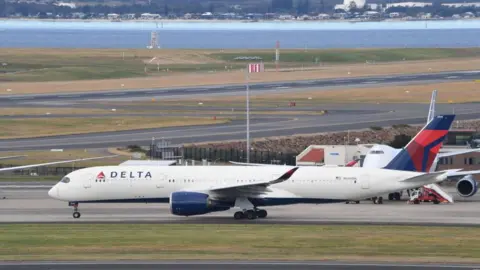
A number of individuals sustained injuries after a Delta flight originating in Los Angeles to Sydney experienced significant turbulence this past Friday.
Flight DL41 "experienced a brief period of turbulence" as it landed at the Sydney airport, an airline spokesperson stated. Four flight attendants sustained injuries.
Local paramedics reported they evaluated five patients, and transferred a trio to a medical facility with non-life-threatening injuries that comprised spinal discomfort and headaches. Those affected ranged from their 30s to 70s.
It is the newest example of planes being hit by turbulence, with aviation specialists saying that global warming is a significant contributor.
There were 245 passengers and 15 crew members on the aircraft, the representative said, stating that the plane landed "without further incident" at Sydney Airport at 06:48 local time on the day in question.
The NSW Ambulance Service said they received a call just a mere three minutes prior to the plane touched down, and ambulances were ready and waiting at the airport.
The reasons turbulence is becoming increasingly prevalent - and potentially more dangerous.
In the previous year, twenty-five passengers and crew sustained injuries when a Delta Airlines flight, flying from Salt Lake City to Amsterdam, encountered "considerable" atmospheric disturbance just two hours into the long-haul flight, and had to make an emergency landing.
Recently, travelers and staff on a Singapore Airlines flight went through a terrifying brief five-second period of extreme instability. One passenger passed away and numerous people sustained injuries, as unbelted passengers lifted out of their seats and fell back down.
In-flight turbulence is a common occurrence during flights, and while instances of significant turbulence seem to be rising, they are still very rare.
Estimates show that there are approximately 5,000 incidents of significant in-flight disturbance each year, out of a overall number of more than 35 million flights that are conducted around the world.
Intense turbulence is described as when the sudden jolts of a aircraft passing through rough air masses apply in excess of 1.5g-force on your body - sufficient force to lift you out of your seat if you did not have on a seatbelt.
As climate change shifts the conditions in the sky, specialists caution that air travel could become more turbulent: temperature changes and altered air currents in the upper atmosphere are expected to heighten the frequency and intensity of significant turbulence.


